

Oh Hell No
The Democratic (women) Party Term of 2025

Members of Congress do not use a lot of vulgar language in official e-newsletters. Over the 16 year history of DCinbox “crap” has only appeared in 34 messages, “piss” in 3, “shit” in 9, “damn” in 123, “bitch” in 5, and “fuck” in 6. I don’t really focus on this sort of language in any of my research, but over the past year I had a sense that I was reading “Hell no” more than I had before - so I decided to figure that out.
Though I plan to give the short history of who and how this term is used, I’ll give you part of the answer quickly in a visual:
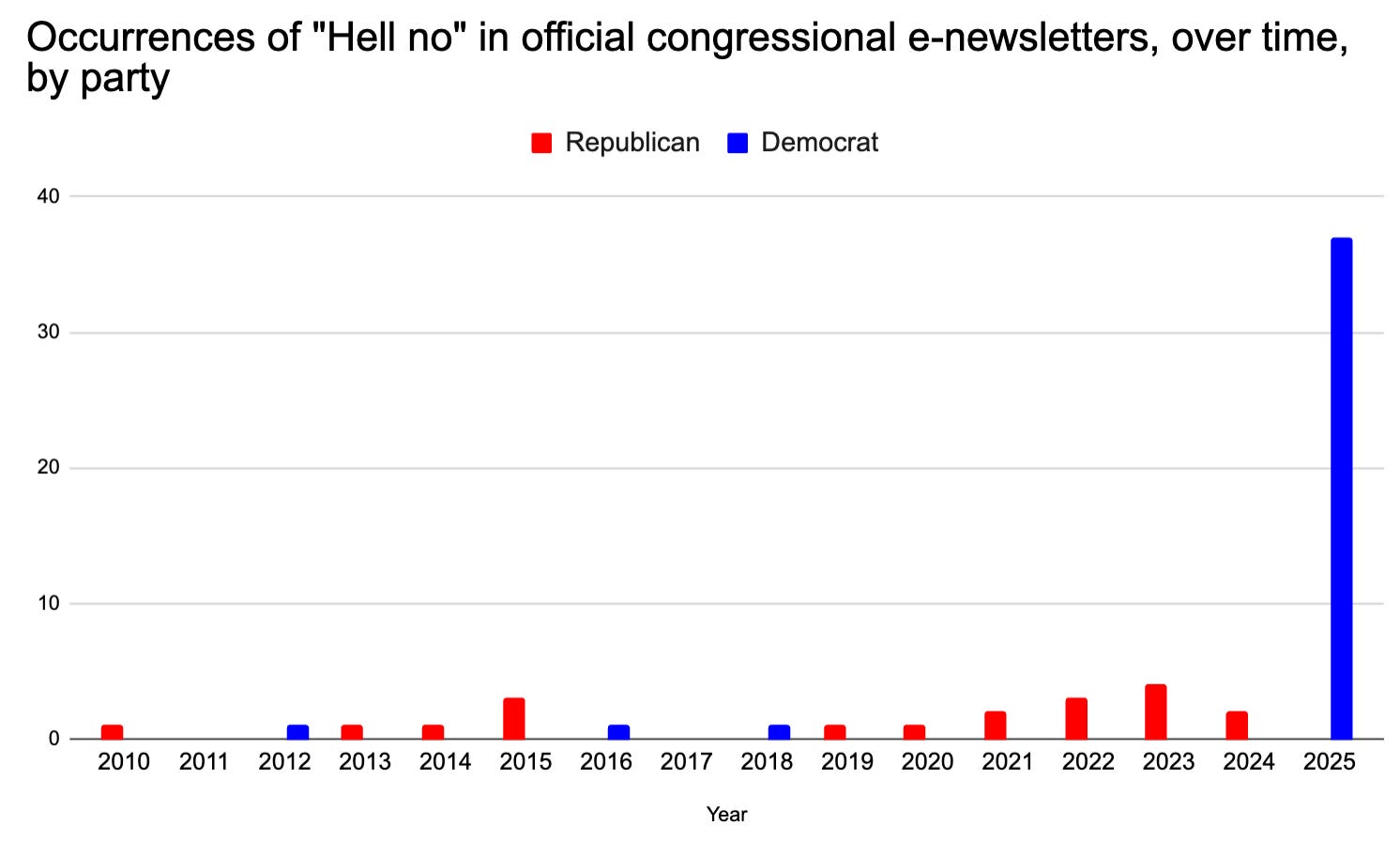
So, yeah, though Democrats weren’t the first to use “Hell No”, it was certainly a party refrain for 2025.
The Short Yet Comprehensive “Hell No” History
On Mar 26, 2010 Congressman Blaine Luetkemeyer (R-MO) was the first to write this term in an official e-newsletter to tell constituents about what then-Republican Leader John Boehner had to say about Democrats using the reconciliation procedure to pass health care changes,
Boehner was a bit of a cusser - so much so that the Washington Post wrote a piece on it in 2015. Boehner and his allies would sometimes refer to the Freedom Caucus as the "Hell No Caucus" because of their inflexibility on a number of their conservative priorities. Representative Matt Salmon (R-AZ) bragged to constituents that he was responsible for Boehner’s decision to leave congress, and in doing that sent a piece from an AZCentral.com article that mentioned the Hell No Caucus label.
There are a small number of messages during the Obama Administration that are used to signal extreme opposition to an idea or policy Obama had. In 2013 Representative Sean Duffy (R-WI), who is currently the United States Secretary of Transportation, said that his position on Obama’s foreign policy plans for Syria had moved from “no” to “hell no”. In 2015 Congressman Blake Farenthold (R-TX) describing the Iran Deal wrote, “No need to call me, I’m a “Hell No” vote on this bad deal.” And Congressman Lloyd Doggett (R-TX) expressed his frustration when HHS Secretary Sylvia Burwell came to Congress to testify about options to lower prescription drug prices. He found her testimony mealy mouthed and wished she would have just said “hell no” upfront to one of his suggestions.
Once President Trump was in office for his first term, Congressman Brian Babin (R-TX) offered a (Hell!) No in 2019 in response to impeachment efforts on Dec 22, 2019:
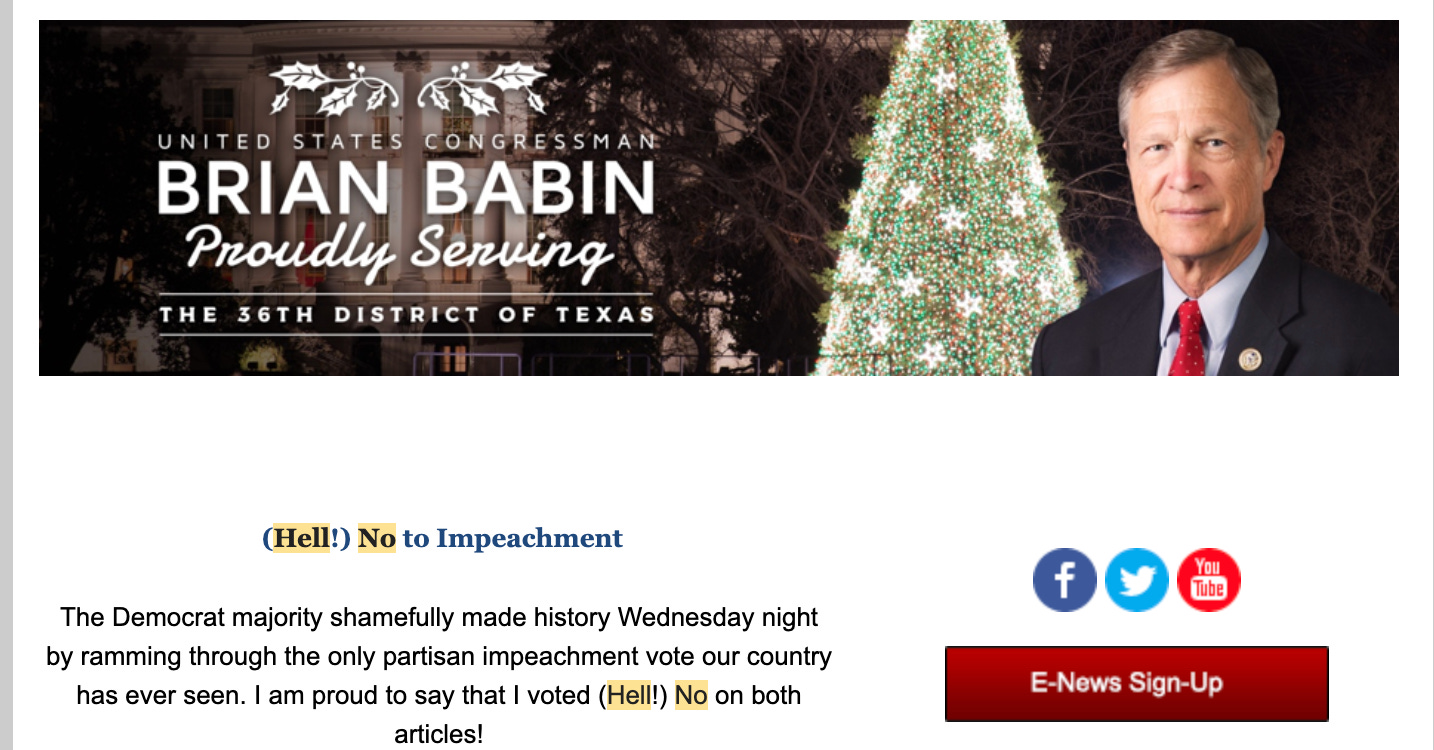
Congressman Jeff Duncan (R-SC) shared a similar sentiment.
When the Biden Administration began legislators went back to throwing a “Hell No” at policy ideas. When discussing the Inflation Reduction Act, Congresswoman Claudia Tenney (R-NY) said, “I voted "NO" on this bill only because there wasn't an option to vote "HELL NO."" Congressman Paul Gosar said the same thing - I say HELL NO! - in response to Biden sending a letter to Congress requesting an additional $38 billion to fund the war in Ukraine. Gosar also said “Hell No to Woke ESG Investments in Retirement Plans” and “I joined 70 of my Republican colleagues in voting HELL NO on this crap sandwich” referring to H.R. 3746, the Fiscal Responsibility Act (which did eventually become law). Senator Ted Cruz (R-TX) sent constituents a link to a Sean Hannity website/newsletter that had a header of, “'HELL. NO.': Cruz Reacts to Democrat Letter Urging Biden to Allow Palestinian Refugees into U.S.”. Senator Roger Marshall from Kansas passed along a Fox News piece with the hyperlink, Sen Marshall urges GOP to say 'Hell no' to supplemental funding request without tighter border security. And Senator Mike Lee (R-UT) when describing a border funding bill and how he planned to vote, wrote “Hell, No” and added a (Sorry, Mom).
In 2020 with the onset of the COVID-19 pandemic and the possibility of collective responses that would reduce some individual liberty like mask mandates in the House, congressional Republicans registered their unhappiness,
Congresswoman Kat Cammack (R-FL) wrote: ‘Hell No’ To B.S. Vaccine Mandates. And Rep. Massie told constituents, “on COVID Vaccine Funding: Hell No, Joe!”
Democrats Step Into Hell (No)
Very few Democrats prior to 2025 said “Hell No”.
In 2012 Congressman John Garamendi (D-CA) wrote to constituents about an appearance he had on MSNBC’s The Ed Show where he said “No and Hell No” to Social Security, Medicare, and Medicaid Cuts.
But something changed on February 25, 2025. On that day Democrats began to use the phrase more than they ever had before and more than Republicans had in the past. The targets have been exclusively in response to actions of the Trump administration.
Congresswoman Sydney Kamlager-Dove (D-CA) kicked this off in writing to constituents about the first budget vote of 2025:
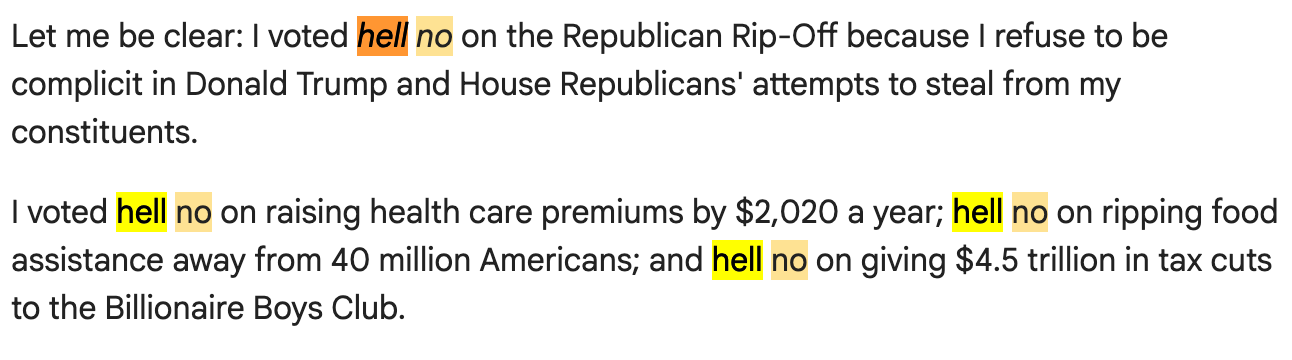
Congresswoman DeGette (D-CO), Rep. Ramirez (D-IL), Senator Chris Van Hollen (D-MD), Congressman Kweisi Mfume (D-MD), Congressman Eric Sorensen (D-IL), shared a similar expression on the budget vote and kept this style up as the conversation moved to funding bills to avert a government shutdown.
Representative Josh Riley (D-NY) shared a Hell No in response to a vote allowing banks to increase overdraft fees. Rep. Jimmy Gomez (D-CA) did on tariff policies. When the SAVE ACT came to the floor, Representative Terri Sewell (D-AL) said, “I didn’t just vote no—I voted HELL no.” and Rep. Ramirez again used the phrase on this vote. Senator Jeff Merkley (D-OR) spoke about his disdain for a rescission package saying he was a “HELL NO when voting for the disastrous package.”
Rep. Lateefah Simon (D-CA) wrote the phrase to constituents when describing a rally in support of the disability community as an attempt to send a message of “Hell No” to Republicans in congress who were working to change pieces of Medicaid policy. Senator Tina Smith (D-MN) described a gathering at the Minnesota State Capitol last month for a rally to save the Boundary Waters saying it was a way to tell Chilean mining giant Antofagasta “Hell No” about the permission to build a copper-nickel sulfide that had been put in the reconciliation bill, aka the One Big Beautiful Bill Act (OBBBA).
By May all eyes were on the OBBBA, and this too created an opportunity for democrats to say Hell No to a vote, as Rep. Melanie Stansbury (D-NM) did.
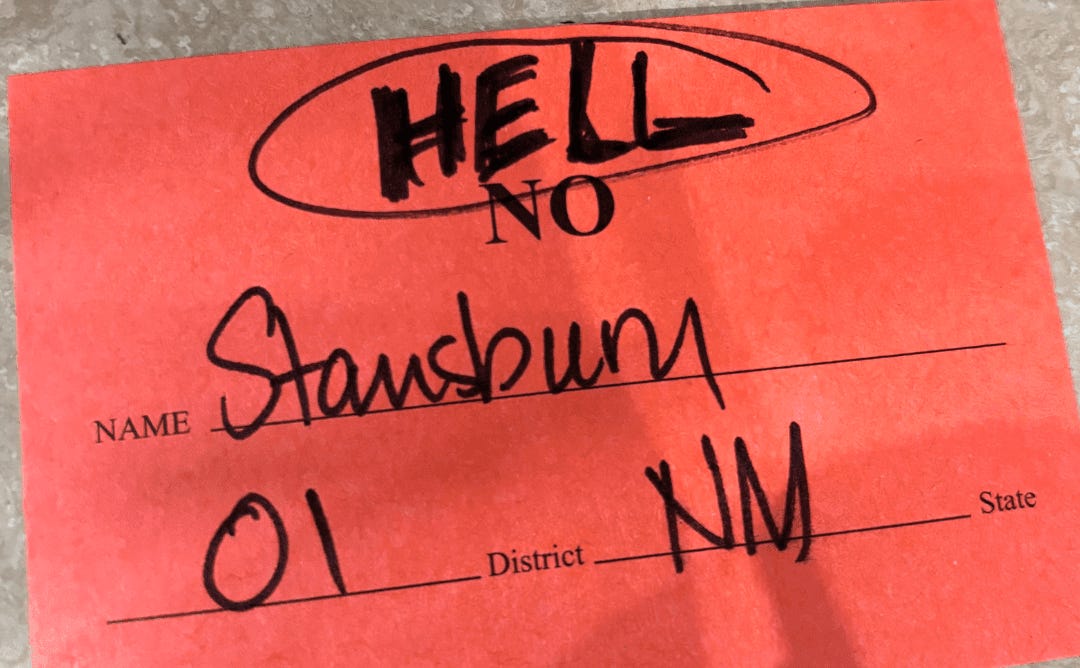
Rep. LaMonica McIver (D-NJ), Congressman Frank Pallone (D-NJ) Sewell, Kamlager-Dove, Tlaib, Simon, and Riley also offered “Hell Nos” on this bill, sometimes over multiple e-newsletters. By this time there’s a pattern emerging where Democratic women started the 2025 Hell No, but men and even those like Riley who had only been in office for about 5 months also thought it was appropriate to use in official e-newsletters.
In November “Hell No” reappeared in response to votes to re-open the government after the shutdown began. Congresswoman Pramila Jayapal (D-WA) described the vote against the effort to reopen the government as “Hell No” because of her opposition to the coming increase in health care premiums because they were not a part of the package. Rep. Eugene Vindman (D-VA), Congresswoman Robin Kelly (D-IL), DeGette, Pallone, Ramirez and Merkley used the term again on this vote.
The final instance of 2025 again comes from Ramirez arguing against the Protect Children’s Innocence Act, “I urged my colleagues to vote HELL NO on the bill”.
Altogether this bump in “Hell No” of 2025 is attributable to 20 Democratic legislators, some of whom sent multiple messages. Most of the Hell No messages came from women, and women of color in particular. Rep. Ramirez sent 6, and the overall share coming from women is 61%. In 2025 “Hell No” moved from a outlier term to a semi-normalized signal of opposition within the minority party, and it’s a neat example of things we can learn and know from having data like these to use.
Here is the Wikipedia article about the 7 dirty words
https://en.wikipedia.org/wiki/Seven_dirty_words
If you could shorten this to one sentence, what would the sentence be?
If you could make it 500 words, what would it be?
Would you be willing to record those with your phone?
TikTok videos can range from 1 second up to 60 minutes, though typical recorded videos in the app are often up to 10 minutes, with shorter options like 15, 60 seconds or 3, 10, 15, 30 minutes available when recording directly, while uploads can be longer; optimal lengths vary, but 21-34 seconds is often cited for high engagement, with newer options for even longer, more in-depth content also being tested and rolled out.